


A Slow Travel Weekend in the Cotswolds Without a Car
The train from London slides past Oxford, the houses thin out, and then the fields begin — wide, pale green, interrupted by drystone walls and the occasional spire. You step off at Moreton-in-Marsh with a small bag and no car keys, and within ten minutes you are walking past honey-coloured cottages towards open country. That is the quiet pleasure of the Cotswolds without a car: the landscape arrives sooner, and you notice far more of it.
This is a two-day plan built around the Cotswold Line, a handful of buses and paths that do the connecting for you. It is deliberately modest in mileage. The point is to arrive somewhere lovely and stay a while, not to bag villages like stamps.
Getting there: trains that actually reach the countryside
The Cotswold Line runs from Oxford through Charlbury, Kingham, Moreton-in-Marsh and on towards Evesham and Worcester. From London Paddington, Moreton-in-Marsh is roughly an hour and a half; Kingham is a similar run and, usefully, closer to Stow-on-the-Wold. If you live in the Midlands or the south-west, Worcester, Oxford and Reading all make sensible railheads.
Two rules make everything easier. First, book the train before you book the bed — advance fares on this line vary enormously, and a flexible ticket bought on the day can cost several times as much. Second, choose one base for both nights. Moving luggage between villages by bus is possible but joyless, and a single base turns a frantic tour into an actual weekend.
Stow or Moreton?
Both are practical. Moreton-in-Marsh has the station, a good high street and the widest choice of buses. Stow-on-the-Golden-Stone has more atmosphere, a handsome market square and sits at the junction of several walking routes.
- Moreton-in-Marsh: easiest for arrival, buses to Bourton, Stow and Chipping Norton.
- Stow-on-the-Wold: more character, better placed for wandering on foot.
- Bourton-on-the-Water: very busy in summer, but handy as a walking hub.
- Kingham: a station and a village, plus a short walk to Daylesford.
Day one: Moreton, the Slaughters and an evening in Stow
Start at Moreton-in-Marsh. Leave the station, cross to the high street, and pick up the Monarch's Way, which heads north-west out of town towards Longborough. It is a straightforward, gently rising path across fields — a good leg-stretcher after the train, with wide views back towards the town.
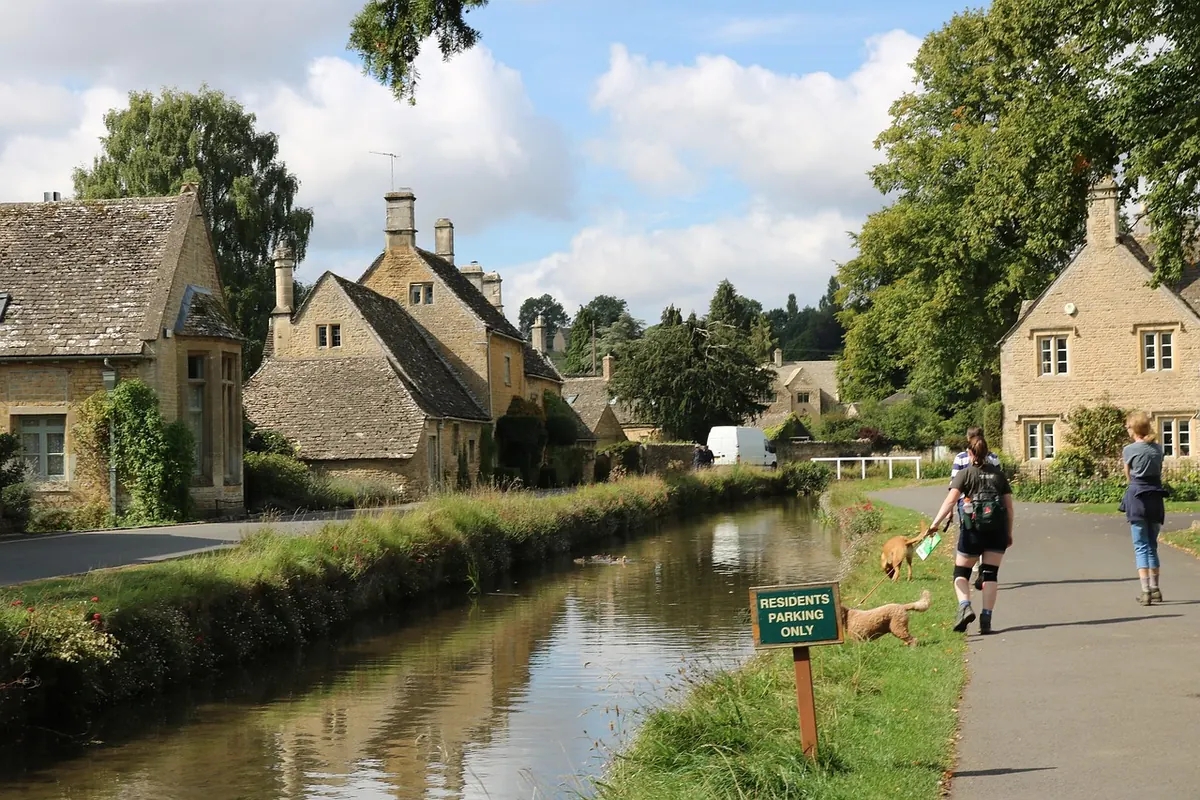
Cut across to the Slaughters in the afternoon. Lower Slaughter has the prettiest approach: a shallow river, an old mill, and a row of cottages that seems to have been arranged by someone with an excellent eye. Upper Slaughter, a short climb up the lane, is even quieter and has a fine old church. These two are worth an hour of simply sitting still.
From there, it is a flat walk of roughly an hour to Bourton-on-the-Water, or a short ride on the bus if your legs have had enough. Bourton is the busiest village in the area and, in August, genuinely crowded. It is still worth seeing — the low bridges over the Windrush are lovely — but go early or late in the day if you can, and use it mainly as a junction rather than a destination.
Stow is your stop for the night. If you are walking, the routes from Bourton via the Wardens' Way are clearly waymarked and take two to three hours. Otherwise, the bus from Bourton to Stow is quick and runs through the day on most weekdays and Saturdays. Book a table for dinner; village pubs fill up, and in winter several close early on quiet nights.
Day two: the long walk to Kingham, or a gentler loop
The best car-free ending is a linear walk that finishes at a station, so you never retrace your steps. From Stow, take the Oxfordshire Way east towards Bledington and Kingham. It is a fine, rolling stretch of about nine miles through farmland, with a couple of steady climbs and long views over the Evenlode valley.
If that sounds like too much, shorten it. Walk Stow to Kingham via Bledington — around six miles — and spend the extra time in Kingham itself, where the village green and the pub are both worth the stop. Daylesford is a mile or so beyond the village if you want a farm shop and a garden to wander round; it sits on the B4450 towards the A436, so check the map before setting off.
A shorter alternative
Base yourself in Bourton or Stow and do a circular walk instead. The classic short loop takes in Bourton, Lower Slaughter and Upper Slaughter, returning along the river — about four miles, mostly flat, with a pub at either end. It works in almost any weather and on almost any timetable, which makes it a sensible back-up if a bus is cancelled or the forecast turns.
Buses, taxis and the reality of timetables
Public transport in the Cotswolds is workable, not abundant. Service 801 links Moreton-in-Marsh, Stow and Bourton; the 855 connects Moreton and Chipping Norton; and the 51 serves the Cirencester and Cheltenham side. Local operators such as Pulhams run much of the network. Two habits keep you out of trouble:
- Check the timetable the day before, and again on the morning. Use the operator's own website or a live travel planner, not a screenshot from a forum.
- Assume nothing on Sundays. Some routes run a reduced service, some do not run at all. Saturday is generally safer than Sunday.
- Keep a taxi number saved. A short hop between villages costs less than a ruined evening, and local firms are used to walkers.
- Leave slack. If a bus is your only way back to the station, take the one before the one you think you need.
What to pack for a car-free weekend
You will be carrying everything, so travel light: one small bag, waterproof jacket, decent shoes with grip, and a refillable bottle. Footpaths here are clay-heavy in places and slippery after rain — boots beat trainers from October to April. Pack a paper map or download an offline version; signal drops in the valleys. And bring a small torch, because unlit lanes between pub and cottage are darker than you remember.
Buy lunch supplies in Moreton or Stow. Village shops are few, opening hours are short, and the nearest thing to a supermarket can be a twenty-minute drive away — which, without a car, is a long walk. Cash helps in the smaller shops and pubs.
Making it work
Two days is enough for one good walk, two or three villages and a long lunch. Resist adding more. The pleasure of travelling here without a car is that the pace is set by your own feet and a timetable you cannot argue with — and that turns out to be a feature, not a limitation.
Keep an eye on weather and travel updates before you set out, and if you are walking long distances alone or in winter, tell someone your route and expected arrival time. Beyond that, all you need is a ticket, a map and the willingness to sit in a pub garden for an hour doing nothing at all.
Photo: vickypawprince / Pixabay