
A Beginner's Guide to Photographing British Wildflowers Without a Macro Lens
The first time you kneel in a summer meadow with a camera, the impulse is to get closer. You want to capture the intricate veins on a oxeye daisy petal, or the precise geometry of a foxglove. But if you are carrying a standard kit lens or just your phone, leaning in often results in blurry, mushy images that lose the very context that makes British wildflowers so compelling. The good news is that you do not need a dedicated macro lens to create beautiful images of the countryside. In fact, stepping back can often tell a better story.
Embrace the Environment, Not Just the Subject
The most common mistake beginners make is trying to photograph a single flower in isolation. Without a macro lens, which allows for extreme close-up focusing, this approach usually disappoints. Instead, shift your mindset from collecting specimens to capturing habitats.
A standard 18-55mm kit lens or a phone camera is brilliant at showing a flower in its setting. Include the swaying grasses, the blurred outline of a hedgerow, or the way the sunlight filters through the stems. This is known as environmental portraiture for plants. By including the surroundings, you give the viewer a sense of place. A solitary poppy against a blue sky is nice, but a poppy trembling in a sea of ripening barley tells a story about the British summer.
Mastering Depth with Standard Lenses
Depth is what separates a flat snapshot from an engaging photograph. Without the shallow depth of field that a macro lens provides, you need to create depth through composition and aperture settings.
Use the Aperture to Your Advantage
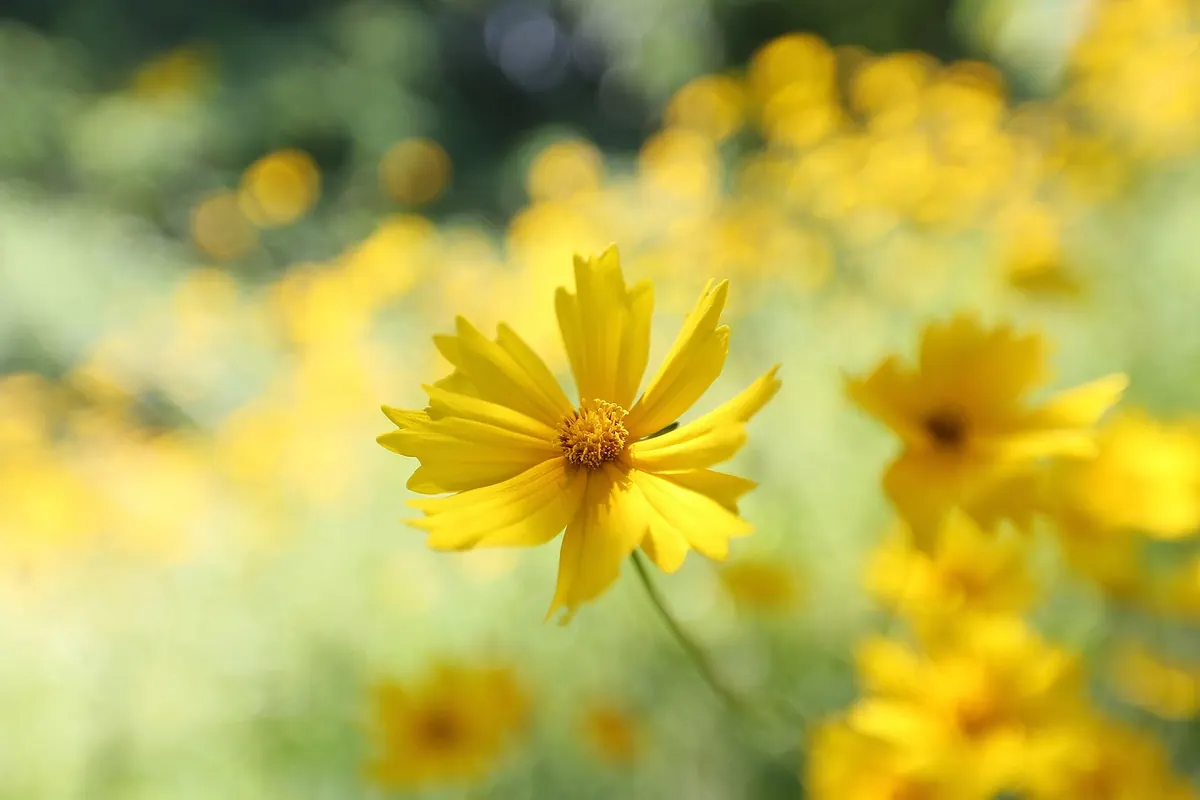
If your camera allows manual control, you can still achieve a soft background. Set your aperture to the lowest number possible (such as f/3.5 or f/5.6 on a kit lens). While this won't blur the background as dramatically as a macro lens, it will separate your subject from the chaos behind it. Get physically close to the flower, but ensure the background is far away. The greater the distance between the flower and the background, the more blur you will create.
The Phone Camera Approach
Phone cameras have small sensors, which naturally result in a wide depth of field—meaning more of the image is in focus. To combat this and create separation, utilise the "Portrait" or "Macro" mode if your phone has one, but be wary of artificial blurring that looks unnatural. A better trick is to tap to focus on the specific flower you want sharp, then use the exposure slider to darken the image slightly. This helps the flower pop against the background. Alternatively, use the physical distance: get very close to a single stem in the foreground and ensure the background is at least several metres away.
Composition Techniques for Wildflower Meadows
When you are faced with a riot of colour and texture, order is essential. Your job is to guide the eye through the chaos.
- Find a hero: Scan the meadow for one bloom that stands taller, leans perfectly, or catches the light differently. Use this as your focal point.
- Change your altitude: Do not just shoot from standing height. Lie on your stomach to shoot through the grass, or stand on a stile to shoot down into the canopy. Getting low creates a "bug's eye view" that makes even the smallest speedwell look majestic.
- Frame with foliage: Use out-of-focus grasses or leaves in the foreground corners to frame your subject. This adds layers to the image without needing expensive glass.
- Leave breathing room: If a flower is facing right, place it on the left side of the frame. Give it space to "look" into the image. Centring everything makes for a static, boring photo.
Practical Tips for Fieldwork
Wildflower photography is as much about physical technique as it is about camera settings. Wind is your enemy, but patience is your friend.
If there is a breeze, you cannot simply hold the camera steady and hope for the best. You need to increase your shutter speed to freeze the motion. On a cloudy day, this might mean raising your ISO (light sensitivity) to 400 or 800. A little grain is preferable to a blurry flower. If you are using a phone, tap the screen to focus, and hold the shutter button down to trigger burst mode; this increases your chances of catching a moment when the stem is still.
Consider carrying a small piece of card or a reflector. You can use it to block the wind from a delicate stem or to bounce light into the shadows of a bellflower. It is a lightweight addition to your bag that makes a significant difference.
Using Colour and Layers
British wildflowers offer a specific palette: the yellows of buttercups and cowslips, the purples of bluebells and knapweed, and the whites of cow parsley. Use these colours to create contrast.
Look for complementary colours. A yellow buttercup against a purple background of distant woodland, or a white oxeye daisy against the dark green of a hedge, creates visual tension. Layers are also crucial. A successful image might have a sharp flower in the foreground, a mid-ground of soft grasses, and a distant tree line. This creates a three-dimensional feel that draws the viewer in. Use a standard zoom lens to compress these layers by zooming in slightly (around 35mm to 55mm), which brings the background closer and stacks the elements together.
Lighting the Landscape
Harsh midday sun is rarely flattering for wildflowers. It creates deep, black shadows and washes out delicate colours. The best light is found in the early morning or late evening—the "golden hour."
At these times, the light is softer and warmer, and the low angle of the sun backlights the petals, making them glow. If you are shooting at midday, look for backlit subjects in the shade of a hedgerow, or use a diffuser to soften the light. Overcast days are also excellent; they act as a giant softbox, revealing detail in the petals without blowing out the highlights. Do not be afraid of a little rain; droplets on petals add texture and interest, provided you protect your gear.
Making the Most of Your Photographs
The work is not over when you get home. A standard lens or phone photo often benefits from gentle editing. You are not looking to deceive, but to correct what the camera missed.
If you were shooting raw, you will have more latitude to adjust the exposure and white balance. For phone photographers, most default editing apps are sufficient. Avoid the temptation to oversaturate colours; British wildflowers are subtle, and neon greens look unnatural. Instead, focus on contrast and clarity. Slightly deepening the shadows and slightly increasing the texture can help the details of the petals stand out without the need for a macro lens.
The most important tool you have is not the lens, but your eye. By focusing on composition, timing, and light, your standard equipment can produce images that feel intimate and evocative, capturing the quiet beauty of the British countryside.
Photo: suhyung798 / Pixabay